

Article
EdTech
7 min read
What worked for 80 students won't necessarily work for 400. It's not because your team lacks expertise or your technology is outdated. It's because there's a fundamental issue with the way your system works. This isn't a tech issue. It's an expansion issue. Before buying better tools, fix the foundation first.
TL;DR (Key Insights):
Manual scheduling and disconnected software are the primary bottlenecks for language schools beyond 200 active students.
Technical debt consumes up to 40% of IT budgets at scale, funding maintenance instead of growth. [4]
Callback delays over 60 minutes cut trial-to-paid conversion by 50%+, making system lag a direct revenue leak. [2]
Legacy integration is the top barrier to scaling AI, not the AI itself. [5]
The fix isn't a longer tech stack. It's consolidating onto the infrastructure built for the load you're carrying now.
The symptoms look operational, but the cause is structural
You already know what this looks like.
A spreadsheet documented the teacher swap. The billing system (unaware of a cohort) was updated. The cancellation of a class was announced late. These aren't isolated admin failures. They're the same failure, repeating at different points in your operation, because the system underneath them was designed for a smaller surface area. The problem is that manual coordination costs more.
With 50 students and four teachers, one coordinator can keep the system running. With 400 students spread across three time zones, group courses, private sessions, and a B2B corporate contract running at the same time, the same coordination method is really difficult. It multiplies. If a cancellation is missed, it becomes a tutor that isn't used, a student that isn't rescheduled, a slot that can't be rebilled, and a corporate contact that tells their HR team about the disorganisation.
What breaks? | School (50 students) | School (400 students) |
|---|---|---|
Tutor idle (lost slot) | $25 | $25 |
Student reschedule | No problem | Likely to forget |
Rework effort | 10 min | 2+ hrs |
Reputation damage | Low | High |
Hidden cost | ~$50 | ~$1200 |
Brookings Institution research on education technology at scale identifies exactly this failure mode: organisations build operational processes for their current load, and when volume increases faster than the infrastructure can process it, the result isn't a visible breakdown. It's slow friction, accumulating across dozens of small moments, until a teacher or an manager burns out or a student quietly stops renewing. [3] This is not due to a staffing shortage, but rather a coordination issue.
No hiring can resolve this.
What technical debt actually costs a school?
Gartner defines technical debt as the implied cost of rework caused by choosing an expedient solution now instead of a more robust one. Their estimate: by 2025, 40% of IT budgets at scaling organisations are consumed by managing existing technical debt rather than building new capability. [4]
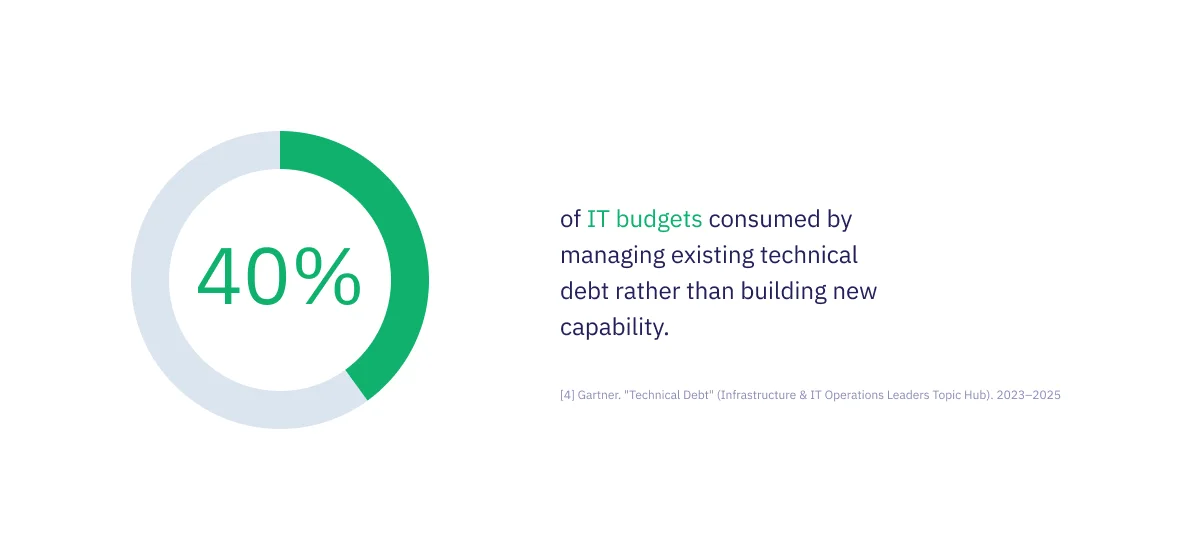 For a language school CEO, translate that number into operational time. If your ops team spends two days a week maintaining workarounds between your LMS, scheduling tool, Zoom account, and billing platform, that's 40% of their capacity keeping the current system alive. None of it is going toward the new corporate client onboarding. None of it is going toward launching the Business English course your sales team has been promising.
The debt compounds. Every new cohort added to a fragmented system increases the maintenance load. Every new tutor hired means another person to manually coordinate. The cost of the old infrastructure doesn't stay flat. It grows proportionally with your student count.
This is the specific mechanism by which growth outpaces the system. Not a sudden breakdown. A slow, steady increase in overhead that eats the margin your growth was supposed to create.
Conversion is leaking, and you may not have traced it to the system
Here's the number that tends to move CEOs fastest: TechCrunch's analysis of EdTech operational benchmarks finds that conversion rates from trial booking to paid enrolment drop 20 to 30% when callback or follow-up response time reaches 30 to 60 minutes. When response time exceeds one hour, conversion drops by more than 50%. [2]
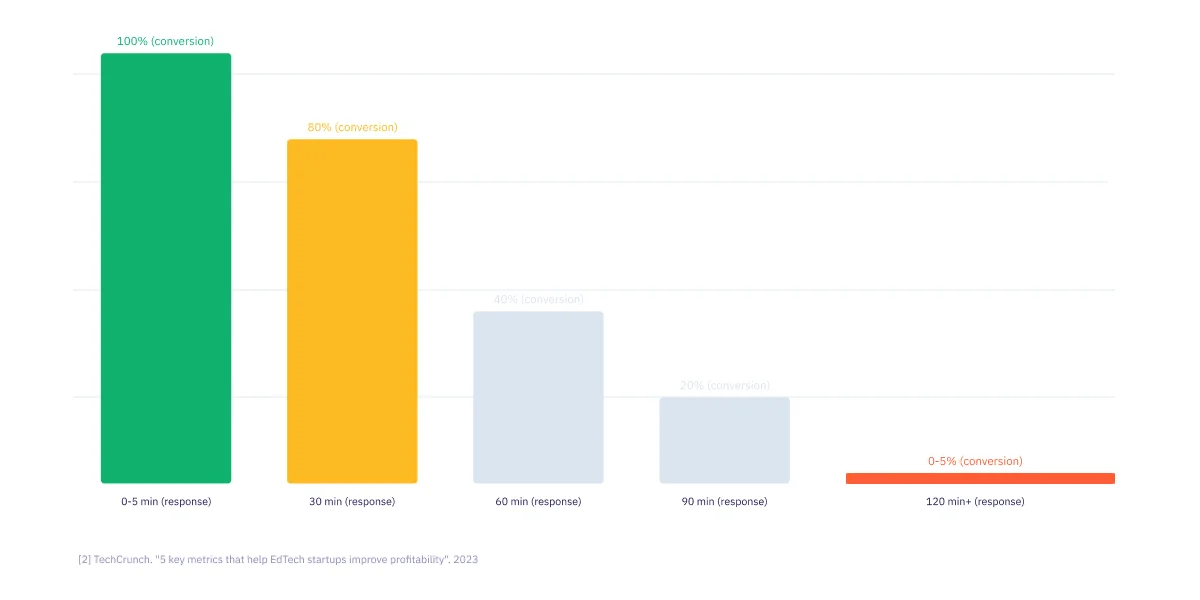 Most school operators attribute slow response time to staffing. They hire another coordinator. The problem persists.
The actual cause is usually a disconnected intake system. A trial booking lands in one place, the tutor assignment lives in another, and the confirmation email has to be manually triggered. By the time a coordinator has assembled the pieces, the prospective student has already booked a competitor's free lesson.
Your product didn't lose that student. Your "infrastructure" did. And because the conversion loss is spread across dozens of individual bookings rather than arriving as one visible failure, it doesn't get attributed to the system. It gets attributed to the market being competitive, which is true, but incomplete.
Legacy systems are also blocking the AI capability you're being sold
The May 2026 breach of Instructure's Canvas platform, in which hackers claimed to have accessed data from approximately 9,000 schools and 231 million individuals, is the highest-profile recent example of what happens when platform scale outpaces security infrastructure. [1]
The lesson isn't that consolidation is dangerous. It's that growth without infrastructure investment creates concentrated, compounding risk.
For most language school operators, the immediate risk isn't a breach. It's obsolescence. Every EdTech vendor is now positioning AI-driven personalisation, adaptive assessments, and automated re-engagement as table-stakes features. Your students, particularly the professional adults paying for Business English, are comparing your platform experience to consumer apps that already have these features built in.
McKinsey's 2026 State of Organizations report identifies the two largest barriers to scaling AI as integration with legacy systems and organisational resistance. The technology exists. The obstacle is the infrastructure it has to run on. [5]
If your current platform can't pass student progress data cleanly between your LMS, scheduling system, and reporting dashboard, an AI layer sitting on top of it will produce noise, not insight. The EU's Digital Education Action Plan addresses exactly this: its interoperability framework sets common standards and protocols for exchanging data across teaching and learning platforms, because without clean data exchange, digital tools operate in silos regardless of how advanced they are individually. [6]
The AI isn't the investment. The clean, integrated data architecture that AI can actually run on: that's the investment.
Your next 90 days have a decision in them
At some point this quarter, you'll either absorb another month of compounding operational drag or you'll make the infrastructure decision you've been postponing.
The schools that win the next phase of this market aren't the ones with the best curriculum. They're the ones whose platforms can onboard a new corporate client in 48 hours, automatically reassign a cohort when a tutor cancels, and send a re-engagement push to a student who missed two sessions, without a coordinator touching any of it. That capability isn't exotic. It's available now, in platforms built specifically for commercial language school operations at scale.
The concrete action is this: map your current tool stack against the five operational moments where students most commonly drop or where staff most commonly escalate. If more than two of those moments require manual intervention, you have your infrastructure brief. Take it to a vendor conversation this quarter, before the next cohort intake adds another layer to a system that's already at its limit.
Frequently asked questions
Why do language school operations break down as student numbers grow?
Processes designed for small cohorts rely on manual coordination that doesn't scale. As student count increases, the number of scheduling conflicts, tutor reassignments, and billing exceptions grows faster than headcount, creating compounding operational drag.
What is technical debt and how does it affect an EdTech platform?
Technical debt is the accumulated cost of expedient system decisions made during fast growth. Gartner estimates it consumes up to 40% of IT budgets at scale, meaning nearly half your technology spend goes to maintaining old workarounds rather than building new capability. [4]
How does slow response time affect trial-to-paid conversion in education?
TechCrunch's analysis of EdTech operational benchmarks found that conversion drops 50%+ when response time exceeds one hour. Most operators attribute this to staffing. The actual cause is usually a disconnected intake and scheduling system. [2]
What is the main barrier to adding AI features to a language school platform?
Integration with legacy systems, not the AI technology itself. McKinsey's 2026 research identifies legacy integration as the top barrier to scaling AI across organisations. Without a clean, unified data architecture, AI tools produce unreliable output. [5]
What should a language school CEO do before selecting a new platform?
Map the five operational moments where students most commonly drop or staff most commonly escalate. If more than two require manual intervention, that diagnostic becomes the requirements brief for any vendor conversation.
References
[1] TechCrunch. "Hackers deface school login pages after claiming another Instructure hack". 2026;
[2] TechCrunch. "5 key metrics that help EdTech startups improve profitability". 2023;
[3] Brookings Institution. "Digital tools for real-time data collection in education". 2023;
[4] Gartner. "Technical Debt" (Infrastructure & IT Operations Leaders Topic Hub). 2023–2025;
[5] McKinsey & Company. "The State of Organizations 2026". 2026
[6] European Commission. "Digital education content: guidelines for teachers and interoperability framework". Date unknown
Share this article on:
More insights

Event
FinTech
Software Development
Systems Integration
Regulatory & Compliance
7 min read
How we built a crypto wallet app (x Oobit) that enables instant tap-to-pay Bitcoin purchases at any store and scales to $700K/month. Learn from our success story.

Article
EdTech
Systems Integration
Data Engineering & Analytics
11 min read
Legacy administrative platforms across European education institutions were procured separately with no shared architecture, creating education data silos that force daily manual reconciliation, while 70% of IT capacity is consumed maintaining these systems.

Article
EdTech
Systems Integration
IT Consulting
12 min read
Over 70% of European universities use a variety of digital systems that don't work well together. It's more important to think about how to integrate and govern the system than to choose the software. Here's why.
Article
FinTech
Systems Integration
Regulatory & Compliance
8 min read
How Open Banking works after PSD2 and what the API economy means for banks, instant payments, and system architecture in Europe.

Article
FinTech
Process Automation
Systems Integration
Regulatory & Compliance
9 min read
Banking process automation enables financial institutions to replace manual approvals with low-code workflows that integrate payments, lending, and compliance in real-time. It ensures PSD2 and KYC/AML compliance while enabling instant payments, such as SEPA Instant and Moldova's IPS, for faster and safer banking.

Event
Cross-industry
Business Strategy
IT Consulting
4 min read
Everyone knows Romania and Moldova for good code at low cost. At Nexus 2025, they showed something else: strategic value at the system level.
IT Consulting
Software Development
Agile Project Management
The digital age is an exciting time for businesses, as new opportunities abound and technology advances quickly. However, it also poses the age-old question: how do we stay ahead of the competition while navigating this ever-evolving digital landscape? At EBS Integrator, we’ve found the answer to this conundrum lies in optimizing work processes and delivering top-notch IT solutions and products. In this article, we’ll reflect on the importance of these processes and explore how partnering with EBS Integrator can benefit your business.