

Article
11 min read
Everyone selling AI will tell you it isn't overhyped. Everyone burned by a failed pilot will tell you it is. Both are answering the wrong question. Is AI overhyped? Narrowed to your own operations, the answer splits in two: yes, as a promise that buying AI produces returns. No, as what a prepared company can do with it.
the short version:
95% of organizations in MIT's 2025 study got no measurable return from their generative AI pilots. [1]
Across 49,843 workers in 48 countries, only 14% use generative AI daily. [2]
The failures cluster around process and data, not model quality. Europe's banking regulator names four: third parties, input data, data governance, oversight. [3]
So what does refusing cost? Not the purchase price you didn't pay. The AI already running in your company without you. [8]
None of that means AI doesn't work. It means the value shows up at a level of maturity most companies haven't reached. That level is reachable, and the first step is smaller than the vendors make it sound. [5]
You've probably had the week that produces the question. A board member brought AI up again. A vendor emailed promising transformation, and you deleted it. Someone in the building is pasting company text into a chatbot, and you're not sure who. Everyone says you need AI, and nobody can tell you what it would do here.
(1st in the EBS AI-maturity series)
How much of AI is actually overhyped?
Start with what the study actually is. MIT's NANDA initiative covered 153 leaders, 52 interviews and more than 300 public implementations in 2025. Serious work, not a census. Against roughly $30 to $40 billion in enterprise spending, 95% of the organizations studied recorded zero measurable profit-and-loss return from their pilots. [1] No measurable return, which is not the same as failure.
The usage numbers point the same way. PwC's 2025 Global Workforce Hopes and Fears Survey asked 49,843 workers in 48 countries how often they actually use AI. Just over half, 54%, had used it for their job at some point that year. Only 14% used generative AI daily, and 6% used AI agents daily. [2] PwC sells AI transformation work, so the finding runs against its own commercial interest, which is part of why it's worth quoting.
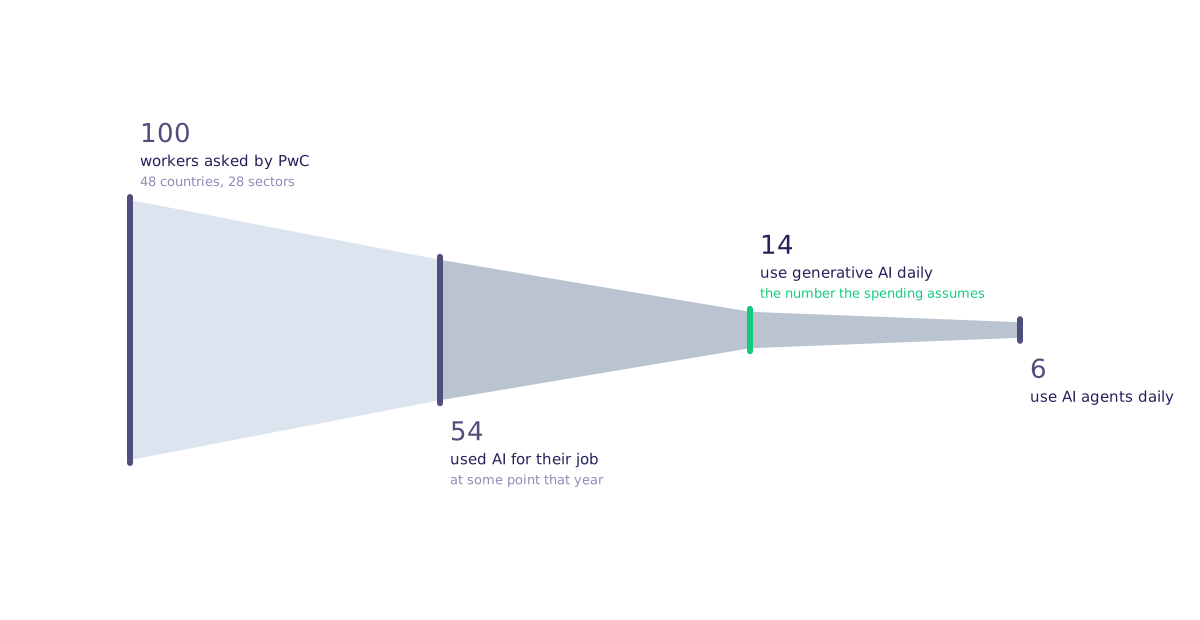
Two measurements, one shape. The spending arrived years ahead of the habits, which is what a technology bought before it was understood looks like from the inside.
Why most AI pilots disappoint?
AI pilots disappoint for a reason that isn't about the model.
AI is essentially an amplifier, says Vitalie Aremescu, founder of EBS Integrator. On an immature company, all it does is expose the gaps you already have in your data, and magnify them, often in public.
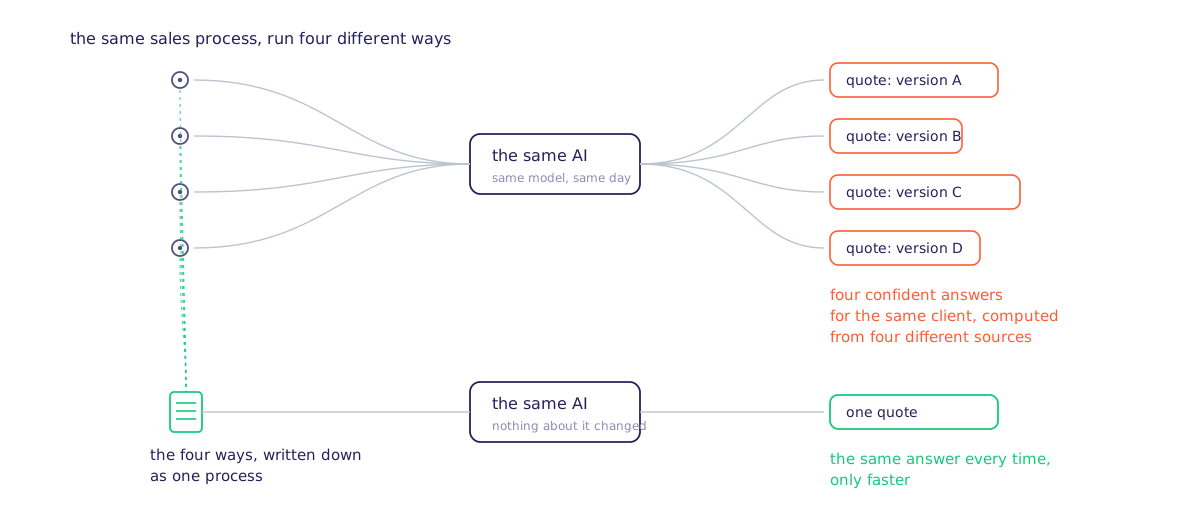
Picture your own sales process. If it's written down and run the same way by everyone, AI makes it faster. If everyone does it their own way, AI produces fast, confident, inconsistent output. Hallucination is the visible symptom, and it's worse than slow output because it carries an air of authority.
The European Banking Authority reached the same conclusion from the regulator's side. Every one of the four challenges above is about the structure around the model. None is about the large language model itself. [3] When a regulator and a practitioner independently name the same four things, that's a finding, not an opinion. We've written about moving an AI system from pilot to production in more depth.
What refusing AI actually costs?
Standing still isn't free either, and the cost isn't the one you'd expect. It isn't a license fee you didn't pay or a competitor pulling ahead. It's simpler. AI resistance stated as policy, "we don't use AI here", doesn't produce a company where nobody uses AI. It produces shadow AI: use that's invisible, unlogged, and running through consumer accounts. The European Commission's Joint Research Centre asked 70,316 workers across all 27 EU member states: 30% already use AI tools at work. [8] That survey doesn't ask whose idea it was, which is the point: a third of European working life already runs on these tools, whatever the company decided.
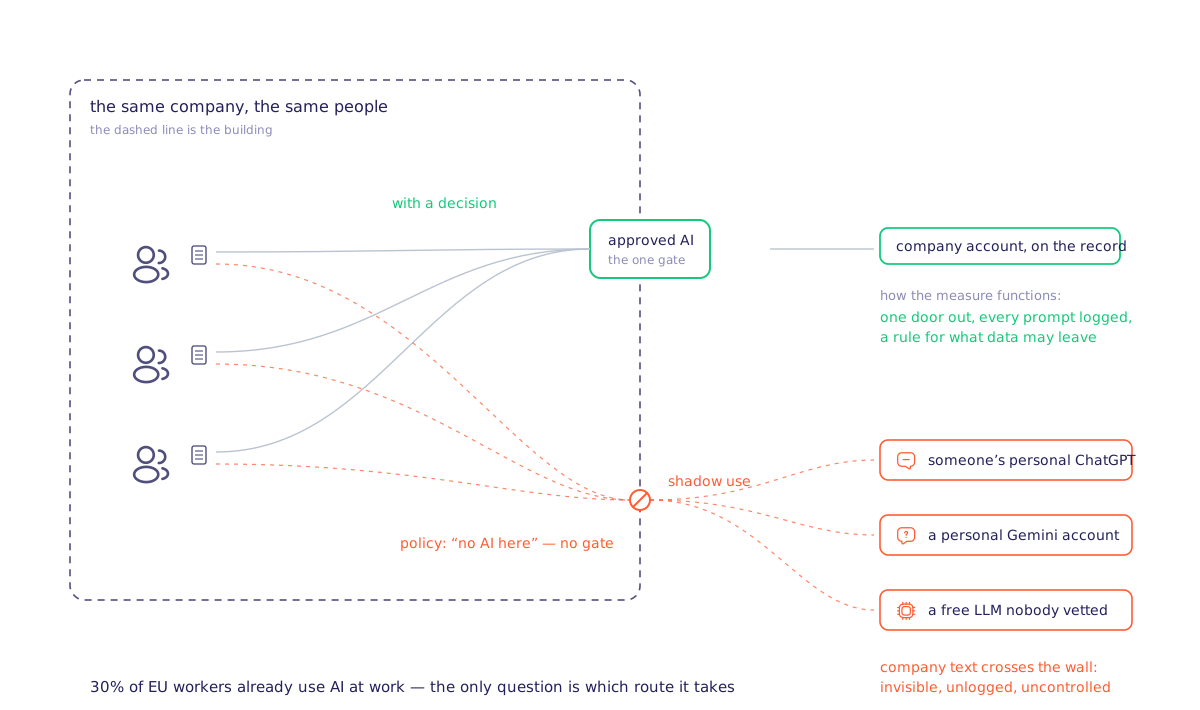
Shadow use is a governance question you already own, and it's answerable without buying anything. Since 2 August 2026 the EU AI Act's transparency obligations apply, most of the heavier high-risk obligations were deferred to December 2027 by the Digital Omnibus, and the embedded systems in Annex I run to August 2028. [4] Most ordinary business uses sit at the light end of that regime, so the regulation is less of an obstacle than the headlines suggest.
The point isn't that the regulation forces your hand. It's that "we haven't decided about AI" and "no AI here" are different positions, and only one of them can be explained to a board.
AI maturity is where the returns start
AI adoption isn't a switch you flip. Our EBS AI maturity ladder sets out nine levels of maturity, from zero to eight.
Table: the EBS AI maturity ladder, level zero to level eight. Full descriptions on our AI consulting page.
Level | What it looks like | Operational Reality |
|---|---|---|
Level 0 | AI is off-limits | 0% ROI. Shadow IT runs anyway. |
Level 1 | People use AI solo | $30K wasted. 0% measured. |
Level 2 | Tools, no system | 12 tools. $100K spent. ROI unknown. |
Level 3 | Teams trained unevenly | Licenses paid. 30% actually adopt. |
Level 4 | Routine work on AI | 20–40% time saved. Capped there. |
Level 5 | AI runs workflows | ROI begins here |
Level 6 | Agents coordinate work | 50%+ less repetitive work. |
Level 7 | Processes built on AI | Cost grows sub-linear. ROI compounds. |
Level 8 | AI self-optimizes | Top 1–2% of companies. Frontier ROI. |
The break sits between four and five: everything below it is preparation. So when a study finds that most pilots produce no measurable return, one reading is that AI doesn't work. The better-supported reading is that most companies are running level-two pilots and expecting level-five results.
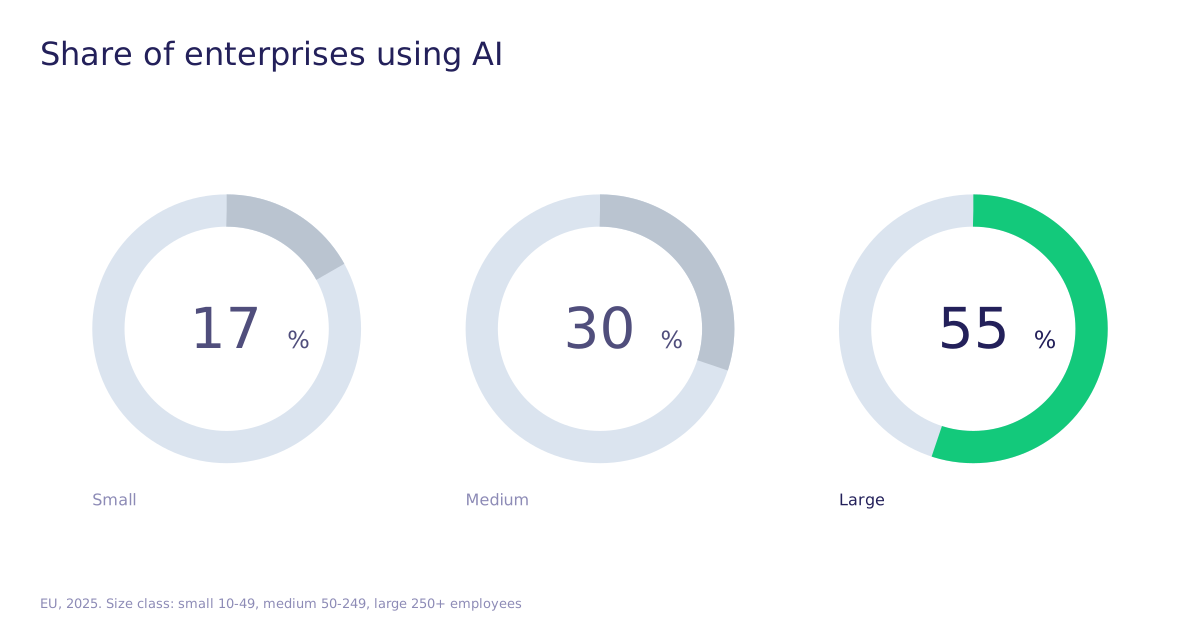
The distribution backs this up. In Eurostat's 2025 data, 20% of EU enterprises used AI at all. Split by size, that's 17% of small companies, 30% of medium, and 55% of large ones. [5] Whatever else that gradient measures, it isn't enthusiasm. Large organizations aren't more excited about AI. They have more written-down process to attach it to.
 In Moldova, 78% of Innovation Technology Park residents now use AI, and 37% run it across the whole business rather than in one corner. [6] Adoption there is arriving faster than the national instruments that measure it, which is worth knowing before concluding that nothing is happening around you.
When not to adopt AI
Staying at level zero a while longer is sometimes the right call. Here are the three conditions that make it one.
Wait if the process you'd point AI at isn't written down. If everyone does it their own way, the conversation you need isn't about AI.
Wait if you can't name the indicator that would move.
"Improve efficiency" is not an indicator. "Reduce the time to produce a quote" is one.
Wait if you can't say what the model vendor does with your data.
"The first thing I think about is what the AI model vendor does with my data," Aremescu says. "That's a legitimate concern. A healthy one, even."
The right response to that concern isn't reassurance. It's an architecture where what defines your company stays on models you control, and everything else can be swapped out. If changing vendor would take you months, something was built wrong.
What AI level zero to level one actually looks like
You don't buy anything to leave level zero. You pick one process, write it down, put one person's name on the output, and set a rule about what data may leave the building.
That's it. No transformation program, no committee, and nothing you can't reverse in two weeks.
The first step off level zero is not a purchase.
Consider the precedent situation from the second industrial revolution, which the economist Paul David set against what he called the modern productivity paradox. Twenty years after Edison patented his lamp in 1880, just 3% of US homes had electric light and electric motors drove under 5% of factory power. [7] Factories weren't wrong to wait, because capturing the value meant rebuilding the plant around it. They'd have been wrong to conclude electricity was overhyped and stop paying attention.
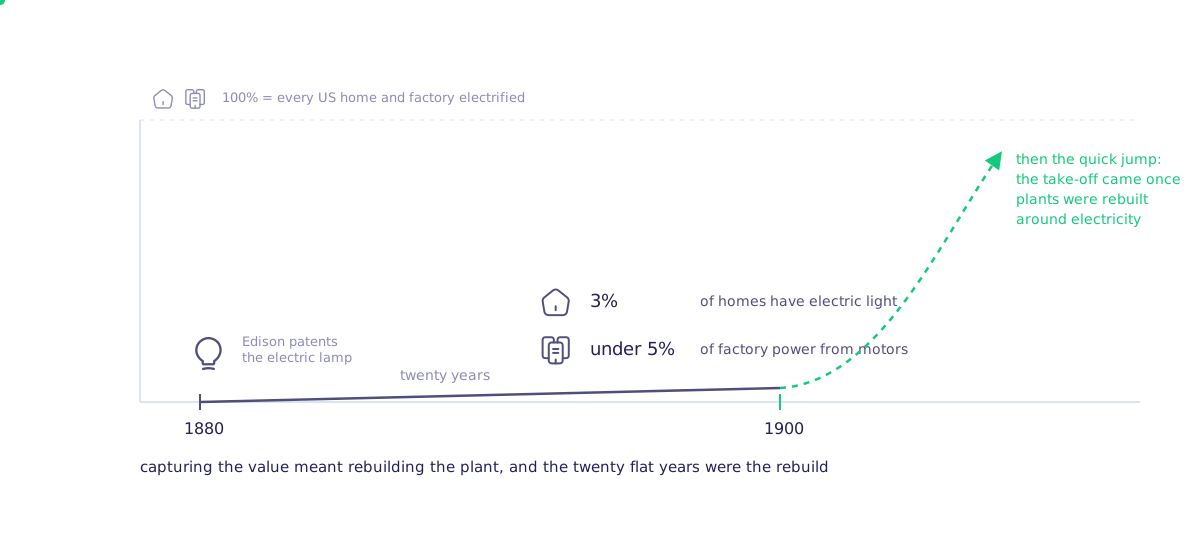 So "overhyped" and "undervalued" were never descriptions of the technology. They describe where you're standing on the ladder. That's the answer worth having ready the next time the question comes up across a table. Not yes, and not no, but which level of maturity you're on, and what the next one would actually take.
Frequently asked questions
How much of AI marketing is hype?
Most AI marketing claims more than the product delivers, which is why AI skepticism is the correct default. A workable filter: ask a vendor which of your processes their tool touches, what indicator moves, and how long it would take to switch away. Vague answers to any of the three are the tell.
Should a small business wait for AI to mature?
Waiting for the technology to mature is the wrong frame, since the constraint is usually your process maturity rather than the model's. A small business with one written, repeatable process is better placed than a large one with none. What isn't defensible is waiting without deciding, because that's the state where shadow use grows unmanaged.
Is it safe to give company data to AI tools?
Keep what defines your business on models you control: your data, your business context, your rules, and anything that identifies a person. The rest can go to external providers. Which data goes where is the whole question, so write the line down, because an unwritten rule is the one shadow use ignores.
References
[1] MIT NANDA, The GenAI Divide: State of AI in Business 2025. 153 leaders surveyed, 52 interviews, 300+ public implementations.
[2] PwC, Global Workforce Hopes and Fears Survey 2025, published 12 November 2025. n=49,843 workers across 48 countries and regions and 28 sectors, fielded 7 July to 18 August 2025.
[3] European Banking Authority, Rising application of AI in the EU banking and payments sector, 25 September 2025.
[4] Regulation (EU) 2024/1689 (the AI Act), as amended by Regulation (EU) 2026/1744 (the Digital Omnibus on AI), in force 27 July 2026.
[5] Eurostat, Use of artificial intelligence in enterprises, dataset isoc_eb_ai, data extracted December 2025. Enterprises with 10 or more employees, financial sector excluded.
[6] Moldova Innovation Technology Park, AI adoption survey, published 4 August 2026. n=1,560 of 2,798 residents contacted, margin of error ±3%, fielded April to May 2026.
[7] Paul A. David, The Dynamo and the Computer: An Historical Perspective on the Modern Productivity Paradox, American Economic Review vol. 80 no. 2, May 1990, pp. 355–361.
[8] European Commission Joint Research Centre with DG Employment, Social Affairs and Inclusion, AIM-WORK survey (Artificial Intelligence and algorithmic Management in the WORKplace), published 21 October 2025. n=70,316 workers across all 27 EU member states, fielded 2024 to 2025.
Share this article on:
More insights

Article
Data Analytics & AI
5 min read
AI in fintech is everywhere, yet few systems would survive an audit. Why projects stall, what regulators expect, and the three steps that fix it.
21 Jul 2026

Article
Data Engineering
Retail & Consumer Goods
8 min read
Discover how Big Data is changing the retail industry with insights from experts Mariana Dicusari and Iulian Ciobanu. Learn how businesses use data to make smarter decisions, create personalized experiences, and improve customer service with real examples of how Big Data helps retailers stay ahead in today’s fast-moving market.
06 Dec 2024

Article
IT Consulting
Business Analysis
Digital Transformation
6 min read
Learn how consulting has changed—and why it works better than traditional approaches. *Real examples from our porfolio included - showing how it solves problems others couldn’t.
22 Apr 2025

Article
Regulatory & Compliance Advisory
Data Analytics & AI
11 min read
Legacy administrative platforms across European education institutions were procured separately with no shared architecture, creating education data silos that force daily manual reconciliation, while 70% of IT capacity is consumed maintaining these systems.
02 Mar 2026