
Today we’re discussing the merits of Chatbots and Artificial Intelligence (AI) when it comes to providing optimal customer service! We’ll talk about the history of the first chatbots, why they are important for your enterprise and many other questions! For that purpose, we’ve asked one of our colleagues to give us his opinion!

Hello world! My name is Sergiu and one of my passions aside from the QA realm, is Artificial Intelligence! Hence, after a dozenth time discussing this topic in the office kitchen, our editor came up to me and enquired if I’d be willing to share my passion with our readers, (and finally let people have their lunch in peace…). Besides, he already gave AI some bad rep before, I want to balance it out a bit! So here we are!
We’ll be discussing about some notions that we often hear or read about, but never really give it much thought – how does artificial intelligence, and especially chatbots affect our lives? What about their merits from the business perspective? And finally, how does one come around to develop their own chatbot if they need it?
So, what is a Chatbot?
What is a chatbot, and where did it come from? The first documented chatbot in history was created between 1964 and 1966 at the MIT Artificial Intelligence Lab by Joseph Weizenbaum. This computer program was called “ELIZA“. The second chatbot was named “PARRY” and was created in 1972 in Stanford.
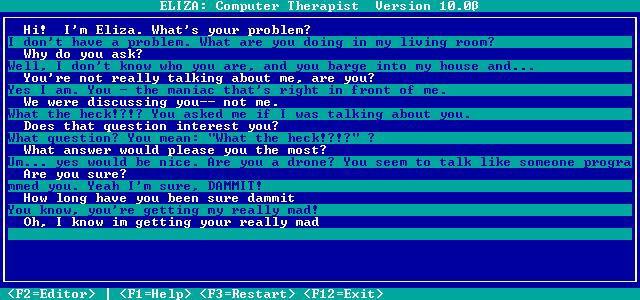
ELIZA was created to demonstrate the superficiality of communication between humans and machines, ELIZA simulated the conversation using a “pattern matching” and substitution methodology that gave users an illusion of understanding from the program but did not have a framework built for contextualization of events.
This means, the chatbot was simply using a set of scripts predefined by the creator. However, at the time, even with Weizenbaum’s insistence on the contrary, many users were sufficiently convinced of ELIZA’s intelligence and understanding.
Today’s chatbot is a communication interface that helps users or companies have automated and successful discourse. Following the same methodology as in 1964, the program follows a strict script of responses as well as a combination of complex algorithms to attempt and imitate a true artificial intelligence.
So much so that currently 1.4 billion people use chatbots for various everyday situations.
Top 5 Countries which see the most use of chatbots – USA, India, Germany, Great Britain, and Brazil.
Our relationships with chatbots?
Its both complicated and fascinating.

According to statistics, following are percentages of consumers with their answers when asked what is their relationship with an artificial intelligence.
- Counsellor: 14 percent
- Knowledge source: 10 percent
- Teacher: 7 percent
- Friend: 6 percent
- Foreigner: 5 percent
- Manager: 4 percent
- Confident: 3 percent
- Colleague: 3 percent
- Opponent: 2 percent
- Spouse / partner: 1 percent
But what is AI – Artificial Intelligence and how is it used?
AI or Artificial System is technically the “ability” of a certain software to accurately mimic human functions such as reasoning, learning, planning or even creativity. All that is done via iterative improvement based on the information it collects at all times.
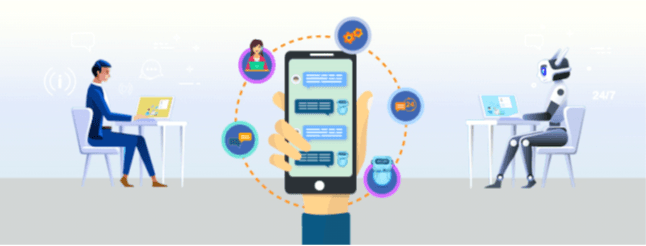
Of course, that is a “how it should be” look, and perhaps sometime in the future, true AI will be present in future applications. However, relative basic AI is already present in our daily lives whether we use our mobiles or web-browser.
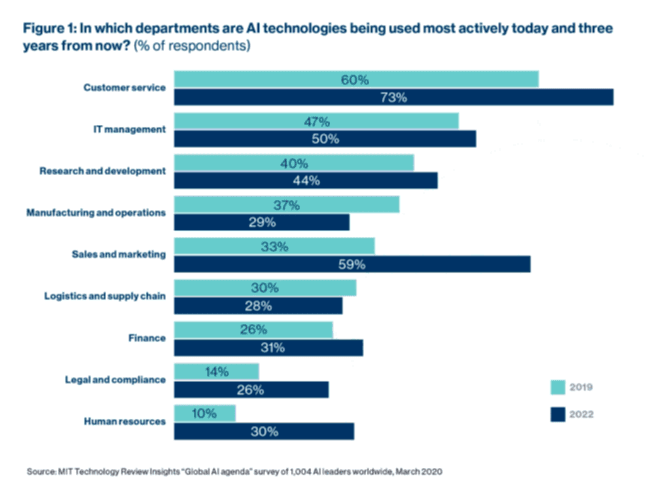
The above statistics show how important AI will be in the coming years. The change is already felt by almost everyone. Considering that the first point of contact between a brand/service with its customers, is often done via some form of a chatbot, or AI at its core.
Did you know that AI can read your mind? Spooky!
A new methodology has been developed by scientists that can create an image of our thoughts using an FMRI scanner.
The new AI is designed to build an image of the human brain and compare it with other images received from volunteers, learning to distinguish the state of the brain depending on our thoughts and mood.
Whether we shop online or physically, or benefit from certain services, we often reach a stage where we require help due to misunderstanding or simple errors/failures of the systems. Sometimes, simply the overwhelming quantity of choices and options stop us. These are known as Customer Pain Points.
Most organizations offer support to its customers during any stage of the interaction… which brings us to exactly that – Customer Service.
Let’s talk about Customer Service
Customer Service refers to the support services that an organization provides to its customers before or after they buy or use products/service.
This includes actions such as providing suggestions for products, services, or offers, resolving issues and complaints, or answering and serving general questions about the product.
To better understand the importance and changing nature of customer service, let’s investigate the past and see how it was “created” and most important how it evolved.
Customer Services/Support in the past
Before the invention of the telephone, customer support was largely provided in-person or by mail. The introduction of the telephone gave organizations a new opportunity to stand out from competition, providing better and faster services to customers.

Customer Support circa 1960’s
In the 1960’s, the first call centres were developed, which eventually evolved into full-fledged customer service departments. By 1990’s and early 2000’s, with widespread of the internet among the general populace, newer ways of reaching the client and resolving their issues became apparent.
Not only could customers call with a pressing question, but they could also access a company’s website or send an email. In some cases, early versions of chatbots were already making grounds into the customer services, even automatic answering machines/robots were/are a form of chatbot.
In the last decade, social networks, such as Facebook and Twitter, have become the new channel through which customers can interact with businesses. And most of the time, the various interaction you see is done largely by artificial intelligence.
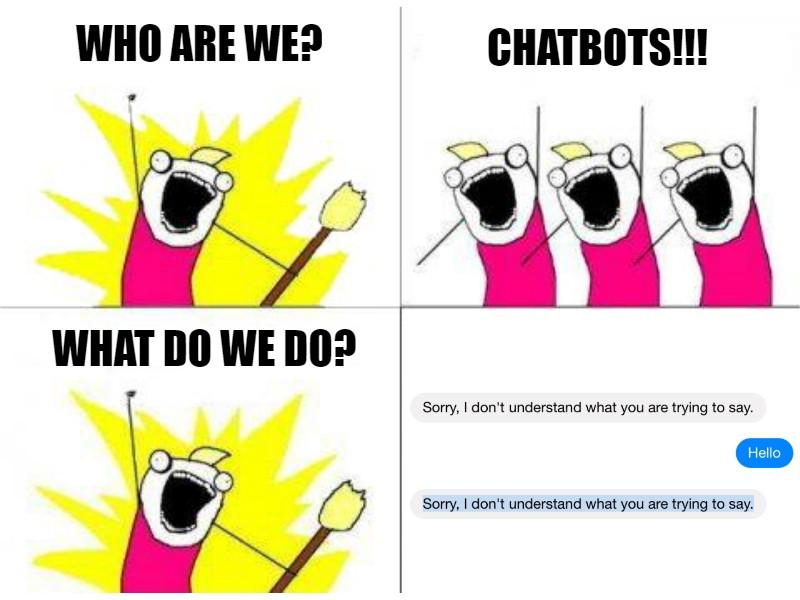
Did you know?
By the way, do you know the difference between customer service and customer support?
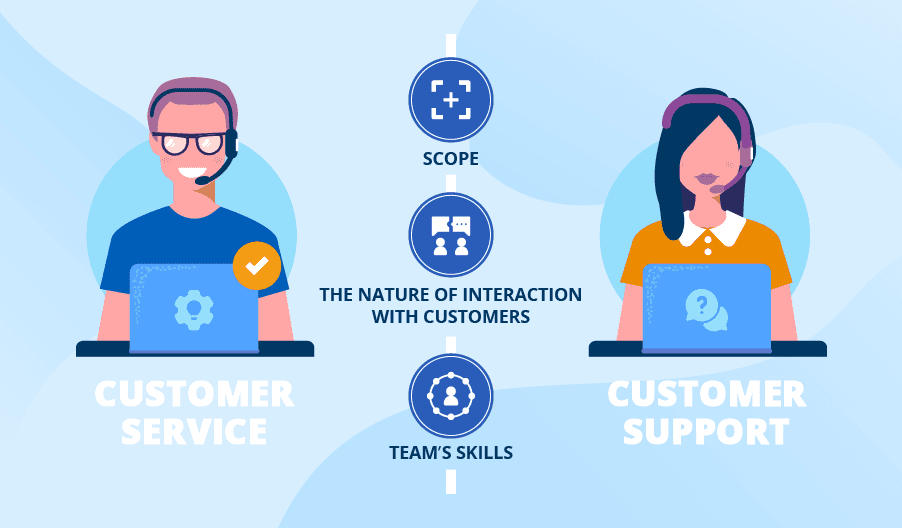
The choice of one or the other between customer support or customer service depends on two factors.
First, what products or services the company provides.
Second, if the products / services need constant technical support.
Customer Support is largely about providing technical support to its customers, while Customer Service refers to giving value through customer support on products and services.
Now let’s bring it all together – Chatbots and Customer Support?
Thus, we have reached the moment when we know what are – Chatbots, AI and Customer Service, we can finally talk about them together. In this digital age, AI technologies are revolutionizing the business world.
Most companies take advantage of artificial intelligence to automate and improve their business operations. AI offers more intelligent and personalized services based on predictive analytics to improve customer experiences.
We’re all incredibly busy, hence people have less and less patience or time to spend on a product. They want instant and personalized solutions, and chatbots with AI meet these requirements by offering customers the opportunity to interact with the organization at their convenience and 24/7 assistance.
This has tremendously positive impact and increases satisfaction of the customers and the success of the organization overall.
But why go AI?
Why, however, a chatbot specifically with a complex AI algorithm and not one with predefined autoresponders? Well, let’s look at the question in more detail.
A chatbot constructed based on machine learning (ML (AI)) does not need predefined questions. It can interpret exactly what you want to say, unlike a version that uses basic scripts, so if you want to give your customers a human experience and not a cold template, then this the ideal way.
This will make you stand out from your competitors, however, with complexity grow expenses. These bells and whistles are also quite expensive and need an extensive database with past questions, answers, and links.
Building blocks to “understand and learn from. But it is absolutely worth the investment if you have a large customer base.
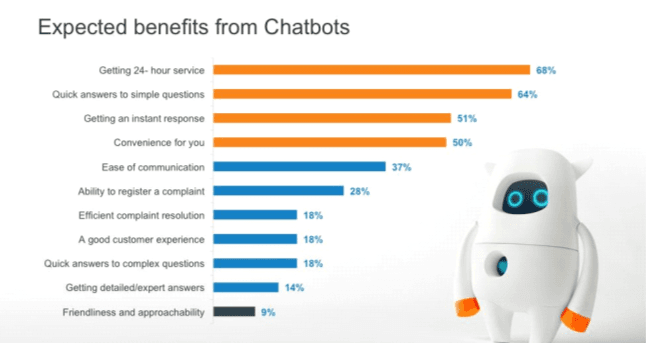
In the table above we see the list of the most frequent answers users gave to the question: what experience or expectations you have from interacting with a chatbot.
The absolute winner and the top expectation are of course: 24/7 availability, quick responses to FAQ (Frequently Asked Questions), and convenience in getting a quick question right there and then.
Otherwise – unresponsive or unreliable customer support
Many of us have had frustrating experiences with companies in various fields such as banking, mobile operators or even state institutions when their representatives called to offer us assistance only after hours or even days of waiting. Sometimes you don’t even receive an answer you were looking for, being left with either more confusion or simply an unresolved issue.

Such situations not only frustrate customers, but also decrease business or brand confidence. Every customer likes to be served instantly or wants a quick response. AI chatbots ensure this instant query resolution.
AI chatbots reduce waiting time by automating the “conversational” customer support process, sometimes even successfully fooling the people in believing they are talking with a life person.
Bots used mainly in customer service – use natural language processing methods that help them analyse customer questions and supply an instant answer that meets customer expectations and needs.
The immediate response simplifies the customers’ experience with the business, thus increasing their satisfaction. Continuing the theme of experience, we must certainly not forget about the advantages for the organization and its business in: reducing costs, increasing sales and improving customer relations – just some of the advantages of using AI chatbots in customer support.
Farewell
And finally, what waits us in the future? Customer Service is and will be evolving still, and no one really knows what the far future holds. What we do know is the present, and currently artificially intelligent chatbots is all the rave!
Know this however, chatbots will not completely take over customer services – there is no way to completely remove human participation. There will always be situations outside the rules when direct human involvement will be needed, but reduced frequency and intensity of such cases due to chatbots and AI will greatly reduce human effort and the costs of a business increasing benefits for both client and organization.
Next time I’ll talk more about the planning and creation process of chatbots as well as more technical look at what exactly is ML based chatbots. We’ll also talk about how to understand the needs of your business and craft the best “chatbot version” for yourself and your customer service/support.
That’s it for now folks, we’ll let our QA specialist get back to the grittier things of software development, down in the trenches so to speak!
What interests you the most about chatbots and artificial intelligence specifically? Tell us in the comments bellow!
Stay classy business and tech nerds!
Share this article on:

Article
Cross-industry
AI Consulting
Data Engineering & Analytics
9 min read
What AI sprawl is, why its return stays invisible, and four moves to control it with the people you have. Level 2 of the EBS AI-maturity ladder.
Article
Cross-industry
AI Consulting
6 min read
AI running on accounts that your company does not hold. This article explains what it is, how it spreads, and how to take it to the next level. (AI-maturity series lvl 1)
Article
Cross-industry
AI Consulting
Regulatory & Compliance
7 min read
Is AI overhyped? Yes, as a purchase promise. No, as what a prepared company can do with it. The evidence, and what the first step off level zero takes.

Article
FinTech
AI Consulting
Data Engineering & Analytics
Regulatory & Compliance
5 min read
AI in fintech is everywhere, yet few systems would survive an audit. Why projects stall, what regulators expect, and the three steps that fix it.

Article
Retail & eCommerce
Data Engineering & Analytics
AI Consulting
8 min read
Big Data is changing the retail industry. (internal expertise) Learn how businesses use data to make smarter decisions, create personalized experiences, and improve customer service with real examples of BigData applied to today’s fast-moving market.

Article
FinTech
Process Automation
Systems Integration
Regulatory & Compliance
9 min read
Banking process automation enables financial institutions to replace manual approvals with low-code workflows that integrate payments, lending, and compliance in real-time. It ensures PSD2 and KYC/AML compliance while enabling instant payments, such as SEPA Instant and Moldova's IPS, for faster and safer banking.

Article
Cross-industry
Cloud & DevOps
Process Automation
5 min read
From banking to public services, systems don’t fail because of bad code—they fail because of bad delivery. This article shows how EBS Integrator uses DevOps to make deployments predictable, recover in minutes, and scale without chaos. Includes real case studies, expert insights, and a look at the next wave of DevOps—AI, serverless, edge computing, and hybrid cloud.

Article
Retail & eCommerce
Business Analysis
AI Consulting
6 min read
How omnichannel strategies and AI-driven personalization help retailers connect online and in-store experiences, improve operations, and keep shoppers coming back.

Article
Retail & eCommerce
AI Consulting
Data Engineering & Analytics
6 min read
Find out how technology-driven personalization x AI creates closer relationships with customers.

Article
Retail & eCommerce
Data Engineering & Analytics
AI Consulting
6 min read
Reach customers wherever they shop with AI and real-time data. Discover how targeted marketing, a seamless online and offline shopping experience, and predictive analytics can personalize recommendations and boost sales. Our retail expert, Olga, shares practical insights and strategies to help you take your store digital. Read the full article for actionable tips and real-world examples.