
Event
FinTech
7 min read
Crypto wallet app development turns hard where the app meets the phone, the moving price and the licence a card needs in every country. Oobit's 5 years with our team show the plan that gets a payment app built natively through all three, module by module, and why the code should be yours at the end.
the short version:
1 goal, 3 objectives: in 2021 Oobit wanted crypto holders to pay at any Visa terminal with one tap, in every market it could open, with payment volume that grows; no app existed.
4 challenges to solve: the tap works at a real terminal, the shop gets what the receipt says, a new market doesn't mean a new app, customers trust it.
Solutions per problem: native code for the chip, a rate lock for the price, a licensed partner, a financial institution that holds the licence, per market, identity first and keys split between holders.
What it delivered: $700K in January 2026, 13 times September's volume, failed payments down from about 45% to about 25%, and native modules, self-contained parts of the app, that went into Oobit's own app as widgets in early February 2026, with their code.
From 2021 to April 2026 our dedicated iOS, Android and QA team, with a project manager, built Oobit's app natively in
SwiftandKotlin, 12 modules and 15+ integrations, and handed the code over with no vendor lock-in, that is, nothing that needs us to run it.
2021: what Oobit wanted, and what didn't exist yet
In 2021 Crypto.com and Binance were scaling their own crypto cards, while a person holding Bitcoin or a stablecoin, a coin pegged to the dollar, still couldn't pay for groceries with it. The only path ran through an exchange and a bank, slow and costly at every step. Oobit wanted it to feel like having Bitcoin in your pocket: take the phone out, tap, done.
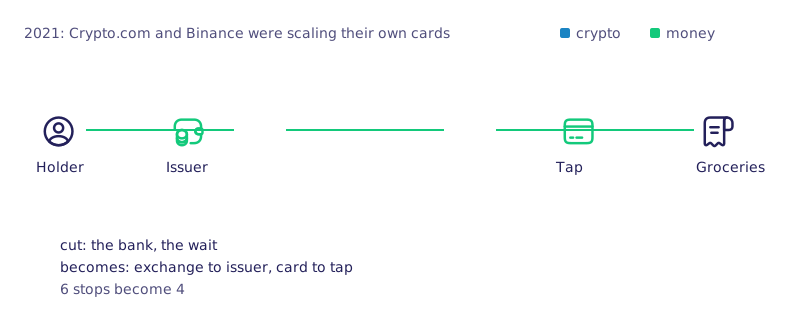 Oobit, an Israel-based fintech, set 3 objectives: a card that pays at any Visa or Mastercard terminal with one tap, every market it could open, and payment volume that grows. The card would earn in OOB, the Oobit token: up to 10% cashback, points on every tap with a multiplier from 1X to 5X, and small leftover balances swept into OOB in one action. The shop would be paid in money, never in crypto.
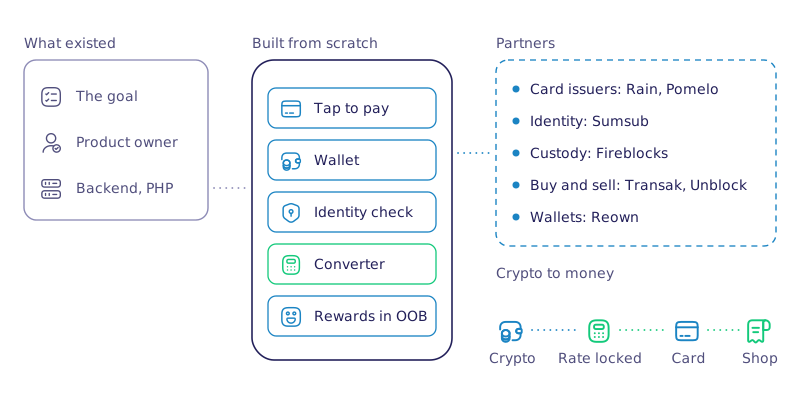
What existed was the goal, a product owner who'd decide every feature, and a backend in PHP, the server side that holds accounts. No mature native app for offline crypto payments, paying with crypto at a real shop terminal, existed anywhere, so the app was built from scratch while payment rails for crypto were still being tested.
The plan: 4 criteria, in the order we held them
We came in through a referral in Oobit's Israeli network and signed within 2 weeks: 1 iOS engineer, 1 Android engineer, a QA specialist and a project manager.
Read against the 3 objectives, the build followed 4 criteria, in this order, for 5 years:
A payment works at a real terminal, through the phone's own hardware.
The shop receives exactly what the receipt says, though the price moves.
A new market doesn't mean a new app.
Customers trust it with their money and their identity.
A rate lock is worth nothing if the tap fails. A new market is worth nothing if payments don't clear there. Trust is worth nothing if the market can't be opened. You aren't just ranking criteria; you're choosing which failure you can't afford first.
Problem one: a tap that works at any terminal
Native first: Swift and Kotlin was the better option in 2021
It all came down to language. A mobile wallet has to talk to three separate layers of a phone: the NFC radio that chats with the checkout terminal, the secure hardware vault holding the digital keys, and the phone’s built-in wallet app.
Back in 2021, if you wanted these parts to talk to each other properly, you went native. For Android, that meant Kotlin; for iPhone, Swift.
Cross-platform tools promised an easier path with one codebase, but they forced every command across a digital bridge that slowed down when calls piled up. In the real world, a tap that hangs at the terminal fails, leaves a line of impatient people behind you and loses the customer.
Choosing native wasn’t a tech debate; it was making sure the app worked when a user was at the counter.
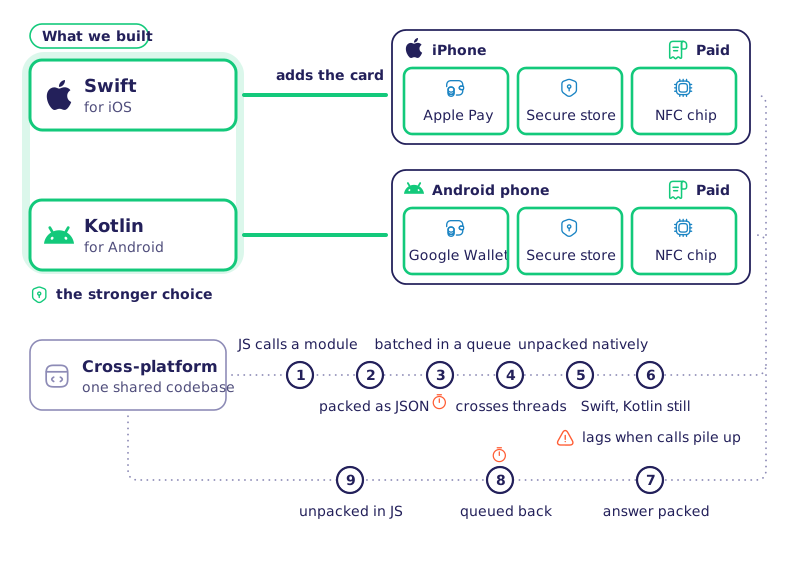
Oobit chose native. They skipped the easy route of buying a pre-made, white-label app because their custom cashback engine and shifting partnerships needed total freedom.
We backed them on that.
Oobit chose a modular cut instead of one giant codebase, and we built the app as clean, independent modules, each with its own screens, logic and tests. When it launched in 2021, it didn’t just work; it became a true pioneer, proving you could tap to pay with crypto at any regular store down the street.
Every module exists to make one moment work:
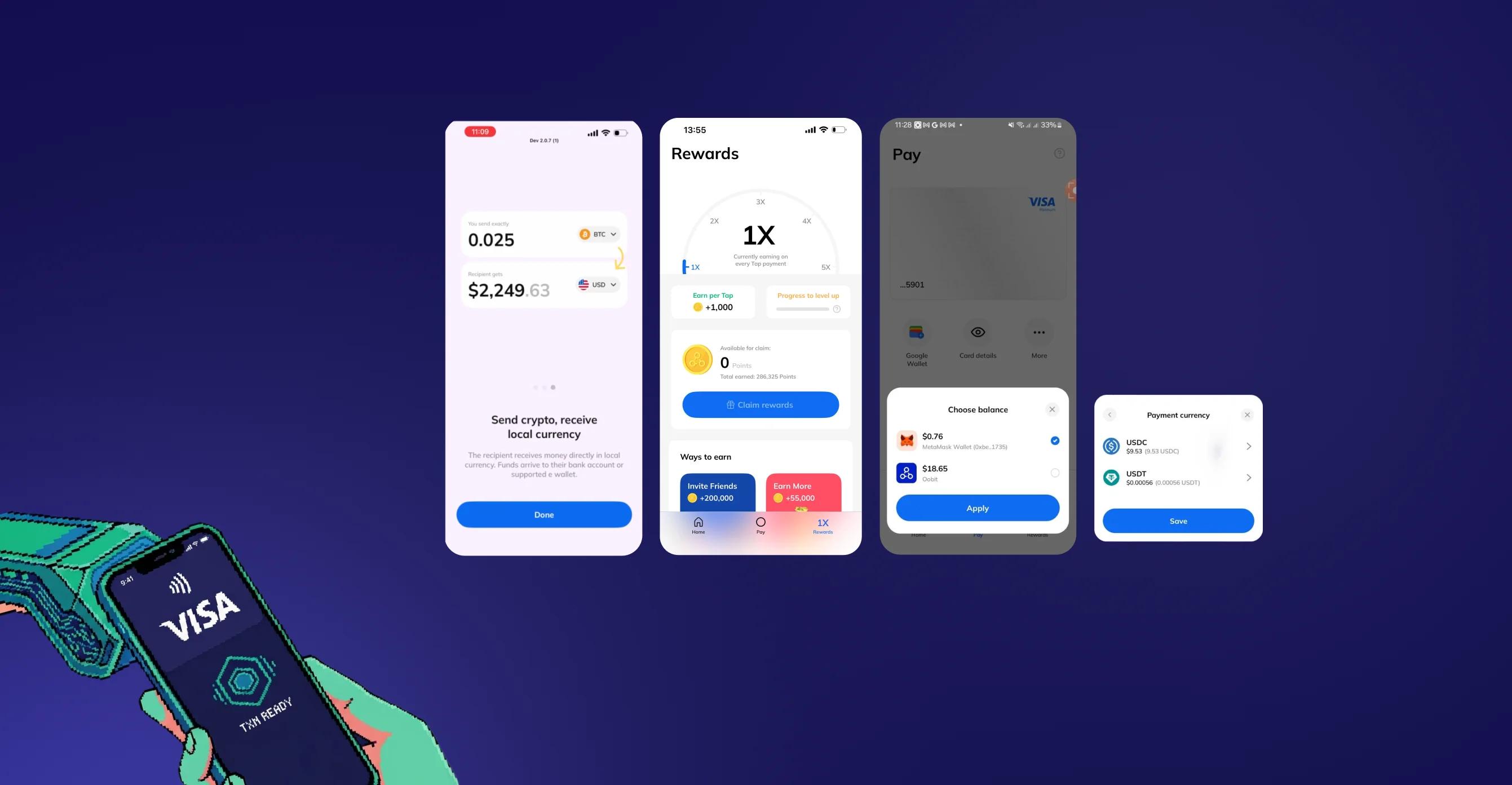
The customer proves who they are once: a document scan and a selfie.
A virtual Visa appears in Apple Pay or Google Wallet in under 20 seconds.
They choose what pays: the balance inside Oobit or a wallet they own, ranking assets if they hold several.
They double-click, pass Face ID and hold the phone near the reader; the price is fixed in that instant.
The shop is paid in its own currency at that price, and the same amount leaves the balance.
Points accrue, and the multiplier climbs from 1X to 5X with use.
Problem two: a price that moves while you pay
The second criterion is the price: a coin's price moves 3 or 4 times a minute while the payment runs. Without a fix, the shop's receipt and the customer's balance would disagree.
Our answer was a converter with a rate lock: the moment the customer holds the phone near the reader, one price is fixed, the shop receives exactly what the receipt says, and the balance moves by exactly that. It took about 3 months of engineering.
Problem three: every market Oobit could open
One licensed partner instead of a licence per country
The third criterion ran into the licence: each country wants its own crypto licence, a regulator's permission to hold and convert digital assets. Acquiring one per market would have put a licence process before every launch.
Oobit chose a licensed financial-institution partner that already holds the licences. Our part was integrating the card issuers, Rain and Pomelo, and PIX, the instant bank-transfer rail Brazilians use, behind the same screens; feature switches and translations enabled fast rollout across new markets. When your plan says "global" on page one, you aren't just adding countries; you're deciding whether each costs a partner or a rebuild.
Rails that could fail
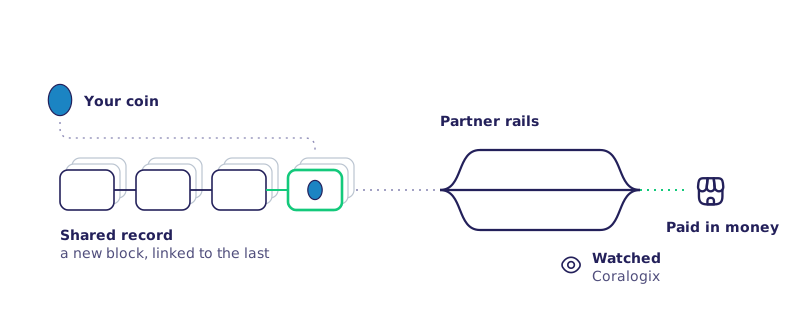
A coin lives on a blockchain, a shared record kept as identical copies on many computers; a payment adds an entry to a new block that carries the fingerprint of the one before, so no earlier entry can be quietly changed.
The partner rails that turn that coin into money a shop accepts were young, and any could fail on a given day. We tuned each integration for stability and watched every one through Coralogix, a monitoring service that collects logs and crash reports.
A backend we didn't own
The backend was Oobit's throughout, so every feature had to be agreed with its team as an interface, the contract between app and server. With production the only environment and that link unstable, Firebase test builds and GitHub Actions, an automated pipeline, the checks every change passes before it reaches a customer, kept each release safe.
Problem four: trust before volume
Identity first, keys split between holders
The foundation is trust, so identity is verified before a single dollar moves. We built the identity check into the app with Sumsub's SDK, a ready verification kit: it checks the document scan and a selfie together and screens the name against global sanctions lists.
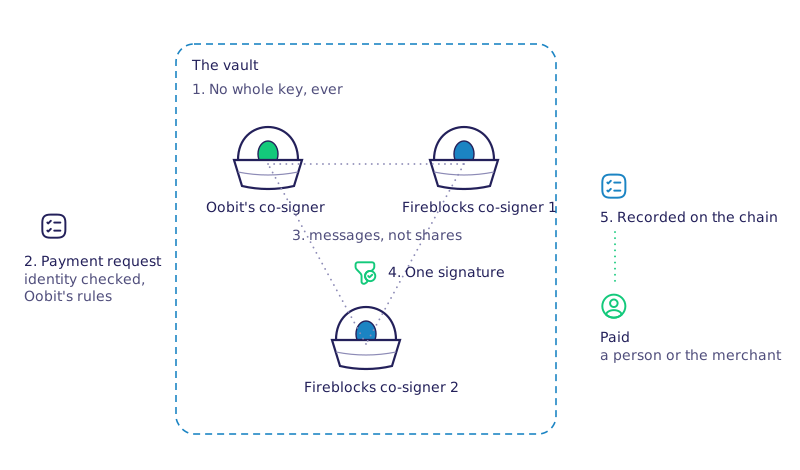
Money kept inside the app sits with Fireblocks under multi-party computation (MPC). The signing key is split into pieces between holders, so no single holder can move funds alone. To test that perimeter, a third party runs a penetration test, a paid attack on the app to find holes, every quarter.
Customers can also keep their money in their own wallet. We built the wallet connection on the Reown SDK, so MetaMask, Trust Wallet and 987+ other wallets connect across 12 blockchain networks. Payments from them run on DePay, Oobit's own payment layer, which we integrated into the app: it pulls the money from the connected wallet only once the payment is approved, with no pre-funded balance.
What the plan delivered
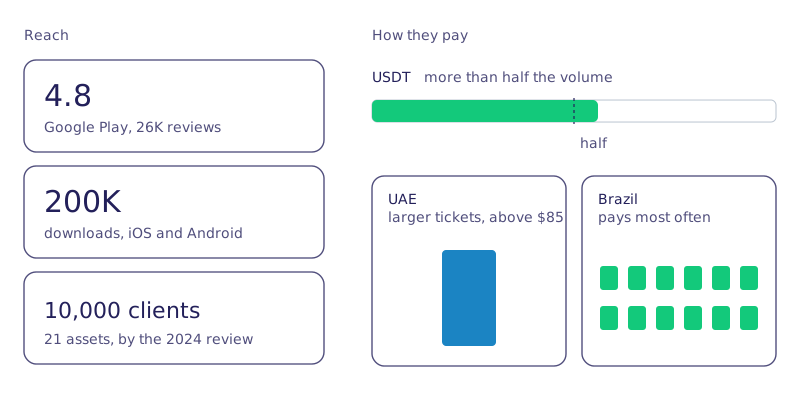
Monthly volume grew from $54K in September 2025 to $700K in January 2026, 13 times in 4 months. Failed payments fell from about 45% to about 25% in under 90 days, and more than 70% of attempts complete. Conversion rose 10 percentage points once one purchase could draw on several assets.
Active users pay about 12 times a month each, up 80% from the early months. USDT, the dollar-pegged coin, carries more than half the volume; the UAE pays in larger tickets, above $85, and Brazil pays most often.
How we worked, for 5 years
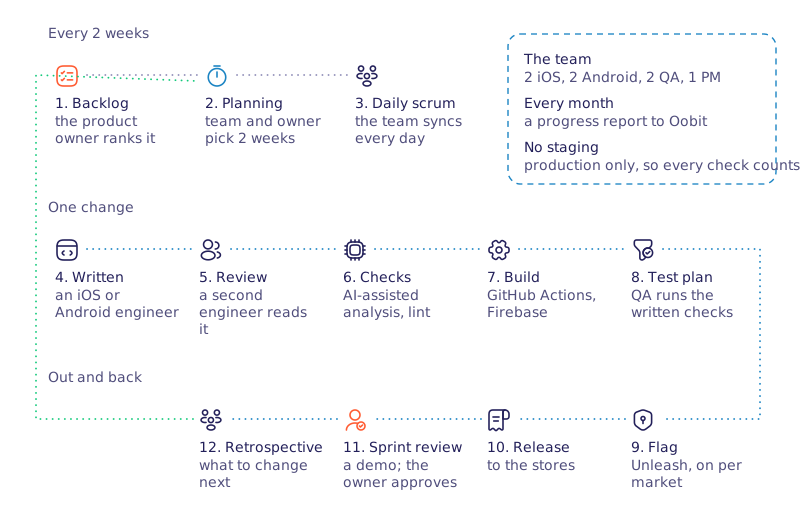 Oobit's product owner ranked the backlog and approved every feature. Work ran in 2-week sprints with a daily scrum, a review and a retrospective, and the team grew from 4 people to 7: 2 engineers per platform, 2 QA specialists and a project manager.
Every change went through review, automated checks and a written test plan, the list of checks a tester runs before a release. When you hire a build team, you aren't just buying its hours; you're buying the discipline that decides what you can take over later.
The handover: the code, and no vendor lock-in
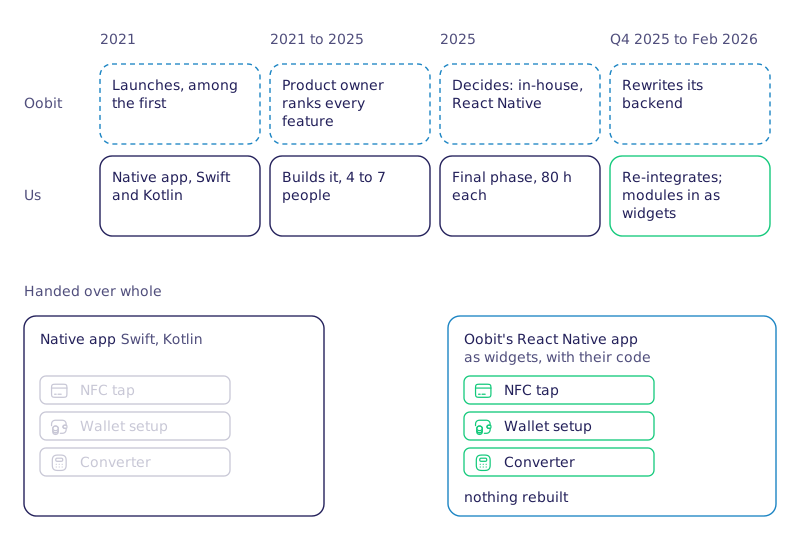 In 2025 Oobit decided to bring development in-house on
React Native, a framework that serves both phones from one codebase. We re-integrated the app when Oobit rewrote its backend in late 2025, and in early February 2026 our native modules went into its new app as widgets, screens it shows as its own, with their code.
No vendor lock-in is a property of the code, not an event at the end: self-contained modules handed over whole, with nothing rebuilt. When you sign with a build partner, you aren't just buying code; you're deciding whether you can take it over.
Frequently asked questions
What did Oobit get at the end of the engagement?
The code of every native module we built, running as widgets inside the React Native app Oobit's team built, in early February 2026.
Who holds the customer's money?
Money kept inside Oobit is held with Fireblocks under multi-party computation, the key split between holders, and Oobit approves transfers under its own rules. Money in a connected wallet stays there until your customer approves a payment.
What were the hardest parts, and how were they answered?
A moving price → a rate lock that fixes one price at the tap.
A licence per country → a licensed partner that holds the licences, with the card issuers integrated behind the same screens.
Young partner rails → tuning and live monitoring on our side.
A backend we didn't own → every feature agreed with Oobit's team, test builds and an automated pipeline.
Share this article on:
Recommended insights

Article
Cross-industry
Software Development
Quality & Testing
8 min read
Explore the key benefits of using version control and release mangement in software development, emphasizing its role in preventing data loss, enhancing collaboration, and improving product quality. See the different types of version control systems and find advice on implementing them effectively. Learn how you can use it for streamlined and successful software projects.
Article
Cross-industry
AI Consulting
Regulatory & Compliance
7 min read
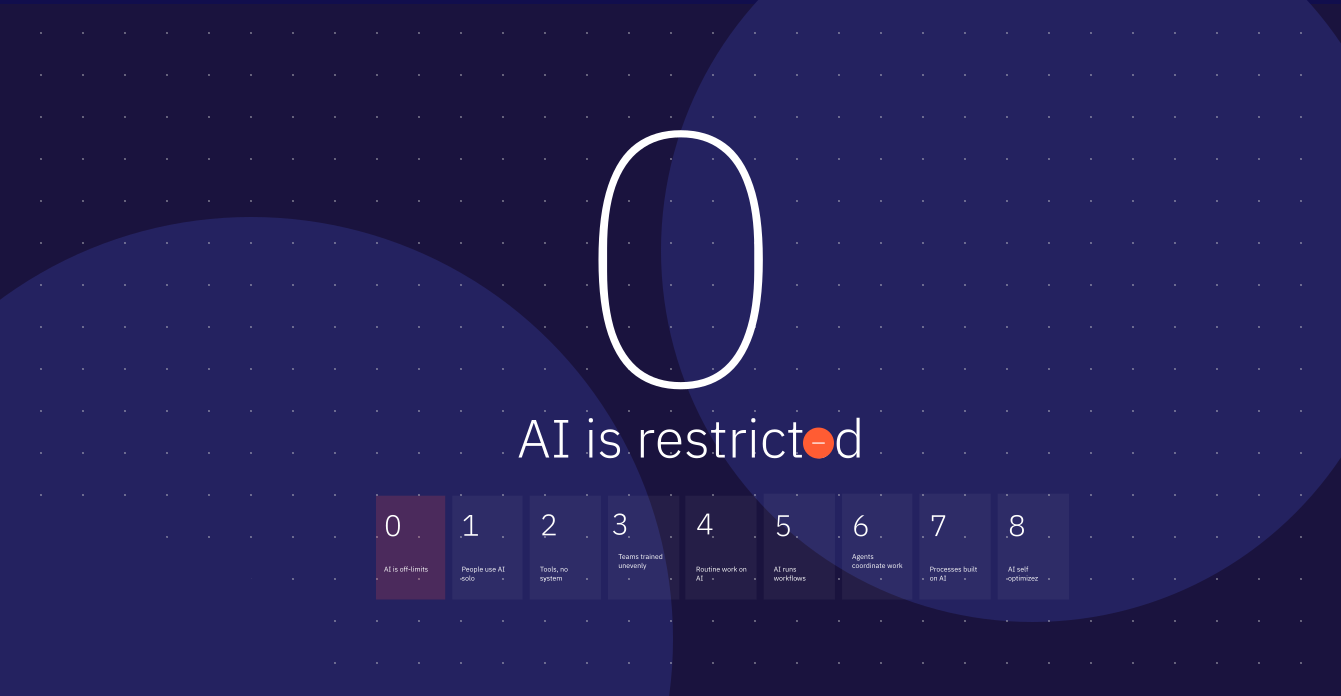
Is AI overhyped? Yes, as a purchase promise. No, as what a prepared company can do with it. The evidence, and what the first step off level zero takes.

Article
FinTech
AI Consulting
Data Engineering & Analytics
Regulatory & Compliance
5 min read
AI in fintech is everywhere, yet few systems would survive an audit. Why projects stall, what regulators expect, and the three steps that fix it.

Article
EdTech
Security
Regulatory & Compliance
11 min read
Student records are among the most sensitive data any institution holds, and the easiest to underprice. What a school breach really costs, and where to start

Article
EdTech
Systems Integration
IT Consulting
7 min read
The technical debt of the system you built for your school eats 40% of IT budgets at scale, and callback delays cut trial conversion by 50%+. Fix the structure before adding more tools.

Article
EdTech
Systems Integration
Data Engineering & Analytics
11 min read
Legacy administrative platforms across European education institutions were procured separately with no shared architecture, creating education data silos that force daily manual reconciliation, while 70% of IT capacity is consumed maintaining these systems.

Article
EdTech
Systems Integration
IT Consulting
12 min read
Over 70% of European universities use a variety of digital systems that don't work well together. It's more important to think about how to integrate and govern the system than to choose the software. Here's why.
Article
FinTech
Systems Integration
Regulatory & Compliance
8 min read
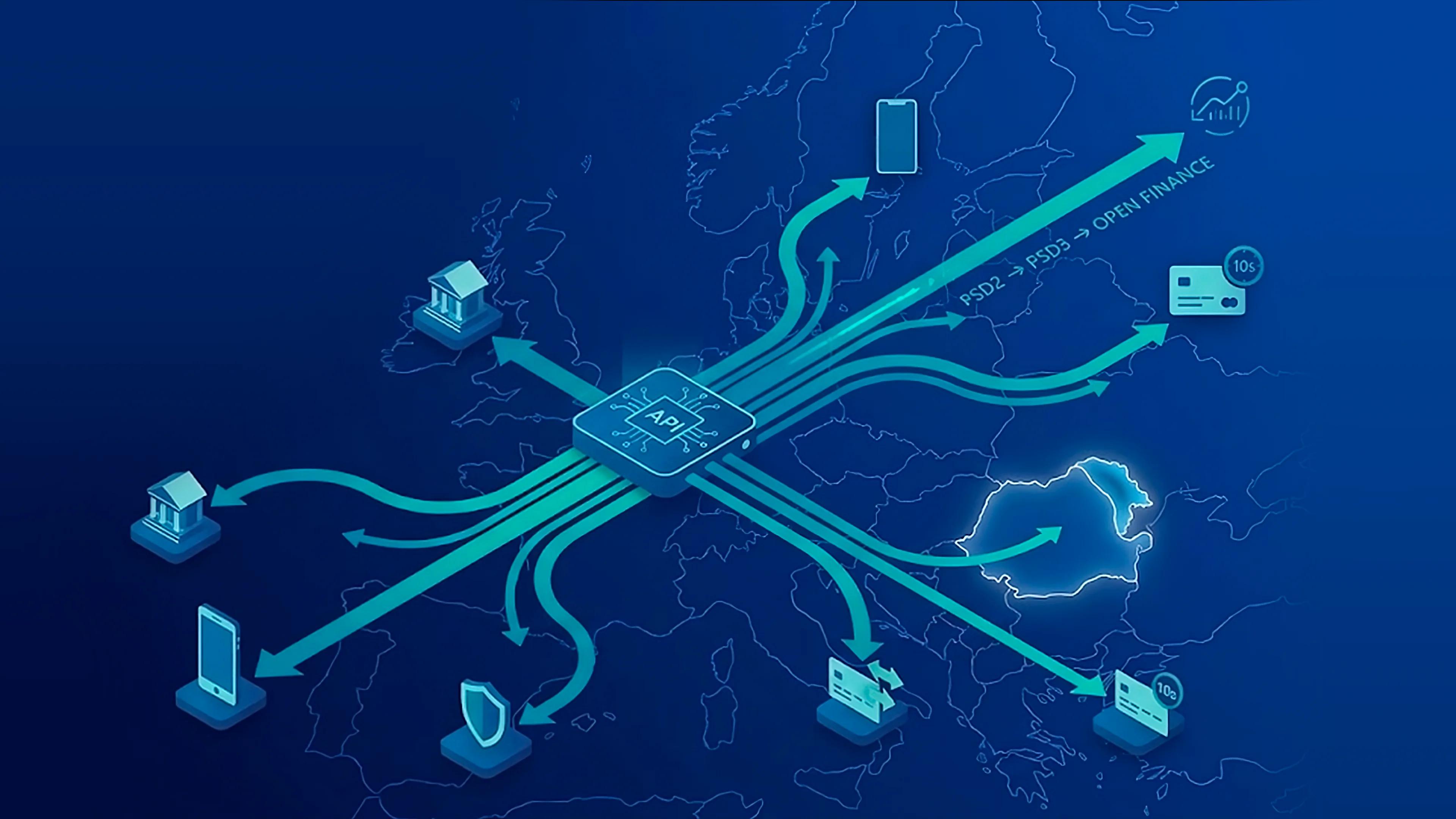
How Open Banking works after PSD2 and what the API economy means for banks, instant payments, and system architecture in Europe.

Article
Retail & eCommerce
Regulatory & Compliance
Security
Business Strategy
8 min read
Learn what an eCommerce audit includes and why EU-linked retailers need it in 2025. Covers security, PCI DSS, ISO 27001, SCA, fraud risk, and business continuity.

Article
FinTech
Process Automation
Systems Integration
Regulatory & Compliance
9 min read
Banking process automation enables financial institutions to replace manual approvals with low-code workflows that integrate payments, lending, and compliance in real-time. It ensures PSD2 and KYC/AML compliance while enabling instant payments, such as SEPA Instant and Moldova's IPS, for faster and safer banking.

Article
Retail & eCommerce
Emerging Tech
Software Development
7 min read
Discover how Augmented Reality (AR) is transforming retail by allowing customers to try products before they buy. Learn how AR enhances customer experience, reduces returns, and increases sales for businesses.

Article
Cross-industry
Software Development
Business Strategy
8 min read
See how mobile apps can boost your business growth. Some remain unaware or have tried without success, but our tech leads in iOS & Flutter prove that modern app development truly works.
Article
Retail & eCommerce
Security
Regulatory & Compliance
8 min read
We’re talking about data privacy in all its glory – why it matters to you and your customers, and where it’s all heading in the future. Because this is a part of a series, we’ll try and focus mostly on the aspects that affect us in the eCommerce domain! Let’s discuss why there’s so much hubbub around the topic of data privacy. This is not to say this discussion is anything new for the world, it’s been brought up countless of times, and the issue of “government spying” on you is as old as the idea of structured government is.

Article
Cross-industry
Software Development
Programming Languages
7 min read
Understand cross-platform vs hybrid app development. Compare frameworks like React Native, Flutter, Ionic, and Cordova. Learn which fits your business needs.

Article
Cross-industry
Data Engineering & Analytics
Software Development
7 min read
Peeling this BASICs digital onion, we’ve left some details out (particularly in our last article). As stated, data-centric and data-driven applications deserve their series, a journey we’re kicking off today. Before talking about BigData, strategies and mechanics, let’s filter the messy data-centric vs data-driven dilemma.
Article
Cross-industry
Security
Regulatory & Compliance
In this article, Alex shares his journey through the implementation of a Clean Desk and Clean Screen Policy during his company's ISO 27001 certification process. Initially resistant to the changes, Alex reflects on the impact of the policy on his workflow, physical security habits, and overall job experience. The transition, while initially perceived as a challenge, ultimately led to a cultural shift within the company, emphasizing the importance of information security and organizational efficiency.

Article
Cross-industry
Programming Languages
Software Development
8 min read
Explore programming history from the 1950s-60s. Discover FORTRAN, LISP, COBOL, and BASIC—the languages that shaped modern coding. Part II of our series.
IT Consulting
Software Development
Agile Project Management
The digital age is an exciting time for businesses, as new opportunities abound and technology advances quickly. However, it also poses the age-old question: how do we stay ahead of the competition while navigating this ever-evolving digital landscape? At EBS Integrator, we’ve found the answer to this conundrum lies in optimizing work processes and delivering top-notch IT solutions and products. In this article, we’ll reflect on the importance of these processes and explore how partnering with EBS Integrator can benefit your business.